Hardness values cannot be precisely converted, but can only be assigned via comparison tables. The calculator interpolated between the support points of DIN EN ISO 18265 and shows the corresponding values in HV, HRC, HB and Rm for each input value – including the areas in which a procedure no longer applies.
Formulas
Rm ≈ 3,3 × HBLarge fist formula
Only for unalloyed steels in the middle hardness range and only for plausibility testing.
HV → HRC → HB → RmComparison of tables
The calculator interpolates between the support points of the comparison table.
Comparison values according to DIN EN ISO 18265
Reference values for unalloyed and low alloyed steels. A stroke means that the method in this area is not usefully applicable.
| Vickers HV | Brinell HB | Rockwell HRC | Tensile strength Rm (N/mm²) | Typical classification |
|---|---|---|---|---|
| 150 | 143 | – | 490 | Stainless steel, soft annealed |
| 200 | 190 | – | 640 | Structural steel, normalized |
| 250 | 238 | 22,2 | 800 | Remuneration steel, low remuneration |
| 300 | 285 | 29,8 | 950 | Remuneration steel, standard range |
| 350 | 333 | 35,5 | 1.105 | Higher remunerated, well machined |
| 400 | 380 | 40,8 | 1.290 | Limit for economical milling |
| 450 | 428 | 45,3 | 1.435 | Hard machining, VHM required |
| 550 | 523 | 52,3 | 1.755 | Hardworking, mostly grinding |
| 700 | – | 60,1 | – | Hardened, sanded |
| 800 | – | 64,0 | – | Tool steel, hardened |
The values are comparative values, not measured results. The agreed test procedure applies for acceptance and documentation.
Fine table
Hardness comparison table HV, HRC and HB in fine steps
App hardness conversion values for unalloyed and low-alloy steels, HV 240 to 800 in steps of 20 HV.
| Vickers HV | Rockwell HRC | Brinell HBW | Origin |
|---|---|---|---|
| 240 | 20,3 | 228 | Support point |
| 260 | 23,5 | 247 | Interpolated |
| 280 | 26,6 | 266 | Interpolated |
| 300 | 29,8 | 285 | Support point |
| 320 | 32,0 | 304 | Interpolated |
| 340 | 34,2 | 323 | Interpolated |
| 360 | 36,4 | 342 | Interpolated |
| 380 | 38,6 | 361 | Interpolated |
| 400 | 40,8 | 380 | Support point |
| 420 | 42,5 | 399 | Interpolated |
| 440 | 44,1 | 418 | Interpolated |
| 460 | 45,8 | 437 | Interpolated |
| 480 | 47,4 | 456 | Interpolated |
| 500 | 49,1 | 475 | Support point |
| 520 | 50,3 | 494 | Interpolated |
| 540 | 51,5 | 513 | Interpolated |
| 560 | 52,8 | 532 | Interpolated |
| 580 | 54,0 | 551 | Interpolated |
| 600 | 55,2 | 570 | Support point |
| 620 | 56,2 | – | Interpolated |
| 640 | 57,2 | – | Interpolated |
| 660 | 58,1 | – | Interpolated |
| 680 | 59,1 | – | Interpolated |
| 700 | 60,1 | – | Support point |
| 720 | 60,9 | – | Interpolated |
| 740 | 61,7 | – | Interpolated |
| 760 | 62,4 | – | Interpolated |
| 780 | 63,2 | – | Interpolated |
| 800 | 64,0 | – | Support point |
Support points are selected reference points according to ISO 18265, Table A.1, as used by the app; interpolated linearly in between. Outside of HV 240 to 800, the app does not count, Brinell only up to HV 600. Reference values, no measurement results and no acceptance test.
Hardness is a process decision
From about 45 HRC on, cutting material, cutting values and often the process change. Heat treatment, distortion and hardness testing are own cost positions and belong separately in the calculation.
Questions and answers
How much HB has steel?
This depends on the condition. According to the comparative table on this page, soft-smelled steel is about 143 HB, normalized steel is about 190 HB, low-remunerated steel is about 238 HB and the standard range of tempered steels is about 285 HB. Above about 450 HB is no longer tested for Brinell; hardened steels are indicated in HRC or HV.
Can one accurately convert hardness values?
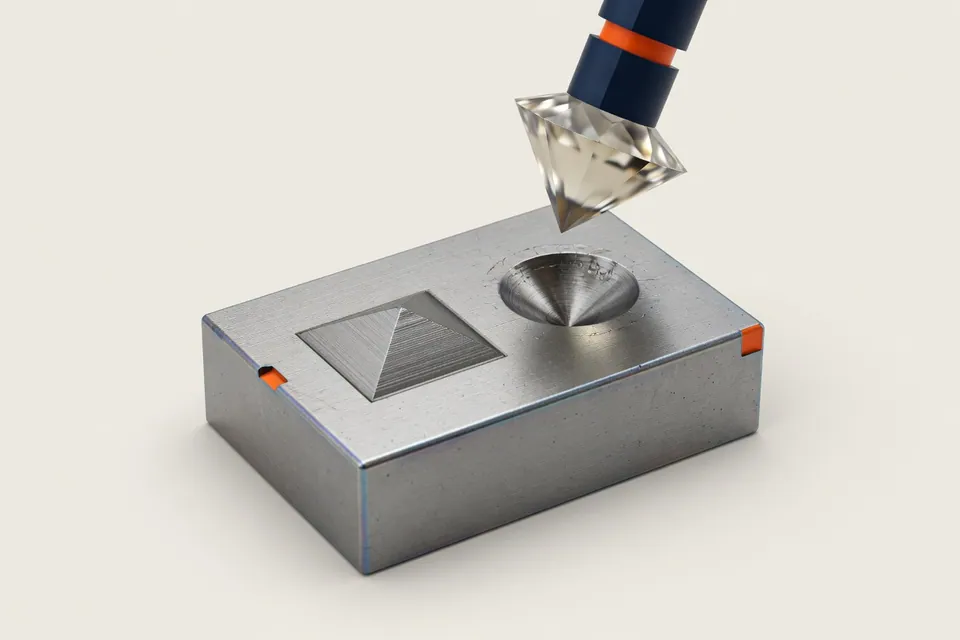
No. HV, HRC and HB measure different physical processes with different indentors and test forces. DIN EN ISO 18265 therefore provides comparative tables, expressly as reference values for unalloyed and low-alloy steels – no universal conversion formula.
What does 45 HRC in HV and Rm mean?
According to the comparative tables, 45 HRCs correspond to about 446 HV and around 1,435 N/mm² tensile strength. A Brinell value is no longer specified in this range because the Brinell test reaches its limit above about 450 HB.
How to convert HB into HV and HRC?
According to the table on this page, 238 HB correspond to about 250 HV and 22 HRC, 285 HB to about 300 HV and 30 HRC, 380 HB to about 400 HV and 41 HRC. Under about 20 HRC, Rockwell C is not useful, above about 450 HB the Brinell test is no longer useful.
What are the limits of individual procedures?
Rockwell HRC is only useful from about 20 HRC, among which HRB or HV is used. Brinell HB is valid up to about 450 HB. Vickers HV covers the largest range and is therefore the usual reference size for comparison tables.
Why is hardness interested in the calculation?
Because it determines the process: from about 45 HRC onwards, special cutting materials, smaller cutting values and more stable conditions are needed; above 55 HRC, sanded instead of milled. In addition, costs are incurred through heat treatment, detachment, rework and hardness testing.
Does the conversion also apply to aluminium or stainless steel?
The tables of this calculator apply to unalloyed and low-alloy steels. For austenitic steels, non-ferrous metals and carbides there are separate tables in other parts of the standard; the tensile strength data are not transferable there.