Grey cast iron and spheroidal cast iron in cut data finder
The app has two cast irons from ISO Group K with their own cutting data: grey cast EN-GJL-250 (5.1301, formerly GG-25) and spheroidal cast EN-GJS-400-15 (5.3106, formerly GGG-40). In the app's material database you can also find both of them using the old short names.
For EN-GJL-250, a density of 7.2 g/cm³, a tensile strength of 250 to 350 N/mm² and kc1.1 1.160 N/mm², for EN-GJS-400-15 7.1 g/cm³, 400 to 500 N/mm² and kc1.1 1.400 N/mm². The app's hints: Grey cast iron is short-breaking and abrasive, dry workable, the cast skin is to be avoided. Sphero cast iron is tougher than grey cast iron and forms longer chips.
Start values for milling, turning and drilling
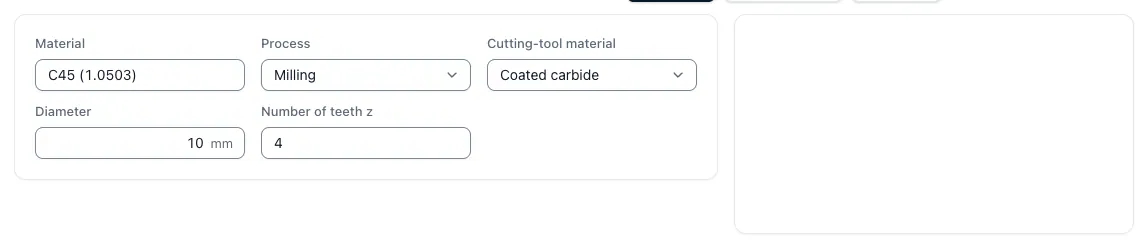
The areas are starting values from the cut data finder of the app for coated carbide. The tooth feed applies to a 10 mm diameter cutter, the drill feed for a 10 mm drill. The data of your tool manufacturer is binding.
- EN-GJL-250, milling: vc 100-180 m/min, start 140 m/min; fz 0.06–0.12 mm
- EN-GJL-250, turning: vc 150–250 m/min, start 200 m/min; f 0.15–0.40 mm
- EN-GJL-250, drilling Ø 10 mm: vc 80–140 m/min; f 0.15–0.30 mm
- EN-GJS-400-15, milling: vc 100–170 m/min, start 135 m/min; fz 0.05–0.10 mm
- EN-GJS-400-15, turning: vc 140–230 m/min, start 185 m/min; f 0.15–0.40 mm
- EN-GJS-400-15, drilling Ø 10 mm: vc 70–120 m/min; f 0.12–0.28 mm
Casting skin, abrasion and dry processing
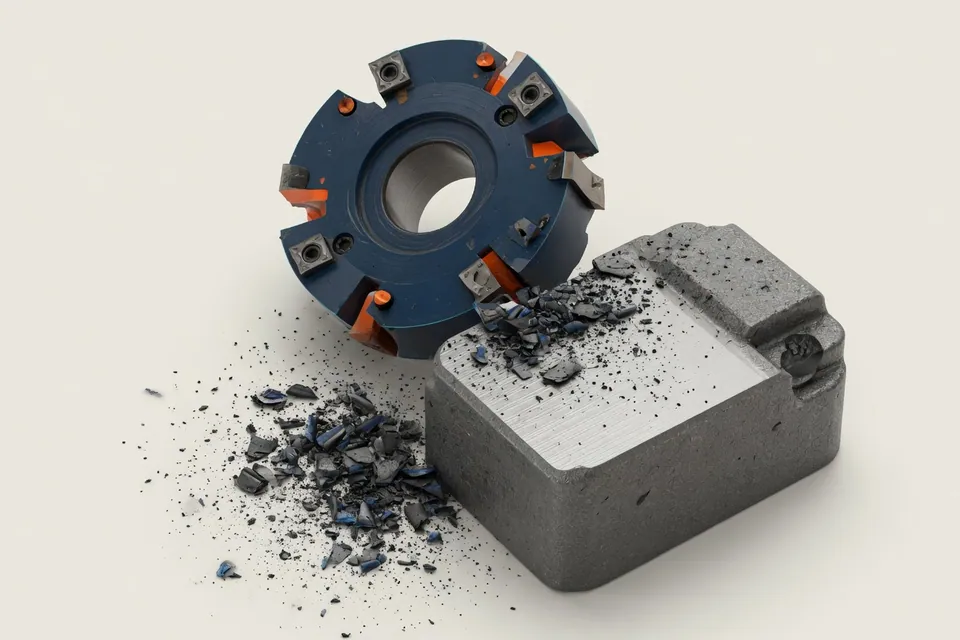
The casting skin is harder and more irregular than the basic structure. If the cutting edge runs into it, it will cover it faster than in the rest of the material. Choose the first delivery so that the cutting edge cuts under the casting skin, and take this into account when machining the stock.
Grauguss is dry workable according to the app. Graphite lamellae allow the chip to break briefly, the abrasion determines the wear. Spheroguss forms longer chips due to the spherical graphite shape, the starting values are slightly below those of grey cast iron, the tooth feed is also in the case of milling and turning.
Further casting grades in the material database
The app's material database lists numerous other cast irons with density and standard. For cutting data, the catalogue refers all grades of grey cast iron from EN-GJL-100 to EN-GJL-350 to EN-GJL-250, the grades of sphero cast iron such as EN-GJS-500-7, EN-GJS-600-3 and EN-GJS-700-2 to EN-GJS-400-15. EN-GJV and EN-GJMW and EN-GJMB are also assigned to vermicular graphite cast irons EN-GJS-400-15.
For bainitic cast iron (ADI) such as EN-GJS-800-10 to EN-GJS-1400-1, the catalogue recommends setting the cutting speed significantly below the values for EN-GJS-400. The app does not give its own figures for these grades. For higher strength cast grades, the starting values of the reference remain a general guideline; manufacturer specifications take precedence.
Power requirements and cost of casting
Cast iron needs less power than steel per machined volume. At 0.1 mm chip thickness and 80 % efficiency, a kilowatt with the values of the app at EN-GJL-250 achieves around 23 cm³/min, at EN-GJS-400-15 around 19 cm³/min and at C45 around 16 cm³/min.
The main time is in the range of steel. With milling cutters Ø 10 mm, three cutting edges, 10 mm cutting depth and 5 mm cutting width, the starting values are around 60 cm³/min for grey cast iron, 48 cm³/min for spheroidal cast iron and 46 cm³/min for C45. The difference in the calculation therefore arises less in the main time than in the wear due to abrasion and cast skin and the stock: A casting stock is usually close to the end contour, the chip volume depends on the extent.
For housings with many holes, the drilling time counts. With a diameter of 10 mm and starting values, grey cast iron drills at a feed speed of around 790 mm/min, spheroidal cast iron at a speed of around 600 mm/min and C45 at a speed of around 560 mm/min; the same bore needs approximately 30% less drilling time in EN-GJL-250 than in C45. When turning lengthwise with the pre-setting of cutting data, both casts are at the level of C45 with 17 to 19 seconds per cut.
For the stock weight, the app stores densities between 7.0 and 7.4 g/cm³ depending on the variety.
Pc = Q × kc ÷ 60,000 kc = kc1.1 × h^(−mc)
Questions and answers
Which cut data apply to GG-25?
For EN-GJL-250 (formerly GG-25), the app's cutting data finder specifies 100 to 180 m/min with starting value 140 m/min and a tooth feed from 0.06 to 0.12 mm, while turning 150 to 250 m/min at 0.15 to 0.40 mm feed.
How do GGG-40 and GG-25 differ when milling?
EN-GJS-400-15 (GGG-40) is tougher and makes longer chips. The app mentions 100 to 170 m/min with fz 0.05 to 0.10 mm compared to 100 to 180 m/min with fz 0.06 to 0.12 mm with EN-GJL-250. The specific cutting force kc1.1 is 1.400 instead of 1.160 N/mm² higher.
Does the app have values for EN-GJS-600 or ADI?
No own EN-GJS-600-3 and other spheroidal castings refer to EN-GJS-400-15 in the catalogue. For ADI, the catalogue expressly advises that the cutting speed is significantly lower than the values for EN-GJS-400. The manufacturer's specifications are binding.
Does grey cast iron have to be processed with cooling lubricant?
According to the app, EN-GJL-250 is dry workable. Whether your tool should run dry or with cooling, specify the information of the tool manufacturer.