Measure KSS concentration with the refractometer
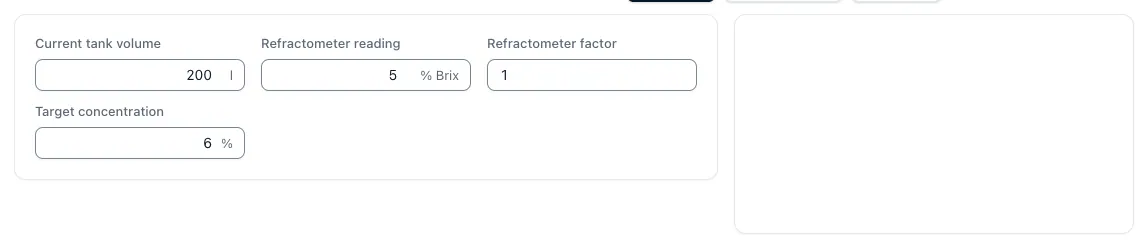
A hand refractometer shows a scale value in percent Brix, not directly the KSS concentration. Each concentrate breaks the light differently; therefore, the manufacturer calls a refractometer factor in the data sheet. The actual concentration is the read value times this factor.
Before the measurement, the device is set to zero with the base water, because dissolved salts in the water itself give a scale value. The sample comes from a rolled area of the tank, not directly after refilling. The light-dark limit is read; if it is blurred, this indicates foreign oil or pollution, and the value is uncertain. The counter-sample is then titration according to the KSS manufacturer.
Foreign oil, dissolved substances and pollution change the display; these influences are not calculated by the app. If the bill is more than 100 percent, it reports a sample, reading or factor error.
c_Is = refractometer value × Product factor
Restart emulsion
For an empty tank, the concentration of concentrate is based on tank volume and target concentration, the rest is water. A 400-litre 5 percent tank requires 20 liters of concentrate and 380 liters of water. This corresponds to a mixing ratio of 1:19, i.e. one part of concentrate on nineteen parts of water.
The target concentration is the setpoint for your procedure released by the KSS manufacturer. When starting, water is provided according to the manufacturer's specifications and the concentrate is added.
V_concentrate = V × c_target ◄ 100 · V_water = V − V_concentrate
Redosing with replacement or pure addition
If the measured concentration differs, there are two ways. When replacing the tank volume, the volume of the tank remains the same: part of the mixture is removed and replaced by concentrate or water. At the pure addition, only the filling level is refilled and the level increases; the calculator shows the final volume so that you compare it with the tank capacity.
If the tank is already below the target by transporting the chips and evaporation, the pure addition is close. If it is full, only the exchange remains. The formulas for both ways:
- Lifting with exchange: V × (c_target − c_is) ÷ (100 − c_is) concentrate
- Raise with addition: V × (c_target − c_actual) ÷ (100 − c_target) concentrate
- Lowering with replacement: V × (c_Is − c_Objective) while water
- Lowering with addition: V × (c_Is − c_Objective)
Example of calculation: 400-litre tank
The refractometer shows 3.2 per cent Brix, the factor according to the data sheet is 1.25, the target is 5 per cent. The actual concentration is 3.2 × 1.25 = 4.0 per cent. When replaced, 4.17 litres of emulsion are taken and replaced by 4.17 litres of concentrate; without removal, it is 4.21 litres of concentrate, and the tank is then 404.2 litres.
Conversely, lowering is costly. If the refractometer shows 6.0 percent Brix, the concentration is 7.5 percent. 133 litres of mixture would have to be exchanged for water for 5 percent or 200 litres of water would have to be added, and the tank would have to hold 600 litres. Thus, overdose costs not only concentrate, but often also part of the filling. The factor 1.25 is an example value, not a value of a particular product.
Test intervals and documentation
How often concentration, pH value and other characteristics of a water-mixed cooling lubricant are tested and how the results are documented regulate the risk assessment of the operation and the rules of accident insurance, in particular the DGUV rule 109-003 "Activities with cooling lubricants". This page deliberately does not mention any intervals; the valid version of the rule and the specification of the KSS manufacturer are decisive.
For the documentation, a test protocol per machine with date, refractometer value, factor, calculated concentration, further measured values and the measure taken, such as the amount re-dosed from the computer, is sufficient.
Concentration, coolant quantity and operating costs
Concentrate is an ongoing block of costs for the machine and is included in the machine hourly rate via overhead costs. Anyone who re-doses after measurement and calculation consumes as much concentrate as the target value requires and no longer. From new approaches and refill quantities of one year and the concentrate price, consumption per machine can be calculated and allocated to machine costs.
The coolant quantity calculator estimates how much coolant must flow through the nozzles: from heat to be discharged, density, heat capacity and permissible heating, the flow rate, from pressure and flow coefficient, the beam speed. With 5 kW heat, material values such as water and 5 K heating, this is around 14.4 l/min; at 10 bar and a coefficient of 0.8, the beam reaches around 36 m/s. The cutting power from which a part with the chips departs gives an indication of the heat.
V̇ = P ÷ (ρ × c × ΔT) · v = μ × √(2 × Δp ÷ ρ)
Sources and classification
- DGUV Rule 109-003 Activities with cooling lubricants, April 2026 edition
Rule of the statutory accident insurance for monitoring, maintenance and documentation of water-mixed cooling lubricants; the valid version is decisive.
Questions and answers
How do I convert the refractometer value into the KSS concentration?
Read-out value times refractometer factor from the data sheet of the concentrate. At 4 per cent Brix and a factor of 1.5 the concentration is 6 per cent.
What is the mixing ratio of a 5-percent emulsion?
1 : 19. One litre of concentrate on 19 litres of water gives 20 litres of emulsion with 5 percent. For 3 percent it would be about 1 : 32, for 8 percent 1 : 11.5.
How much concentrate do I have to refill?
With the same volume V × (c_target − c_is) ÷ (100 − c_is) after the same amount of mixture has been removed, without the withdrawal V × (c_target − c_is) ÷ (100 − c_target). For 400 litres from 4 to 5 percent, this is 4.17 or 4.21 litres.
Where can I find the refractometer factor?
In the current data sheet of the used cooling lubricant, together with the released concentration range. The default 1 in the app is only a placeholder.
Does the computer take evaporation and foreign oil into account?
No. It calculates a pure volume balance of water and concentrate. Deportation with chips, evaporation, foreign oil and measurement uncertainty do not occur; manufacturer data and safety data sheet are given priority.