The Kienzle equation
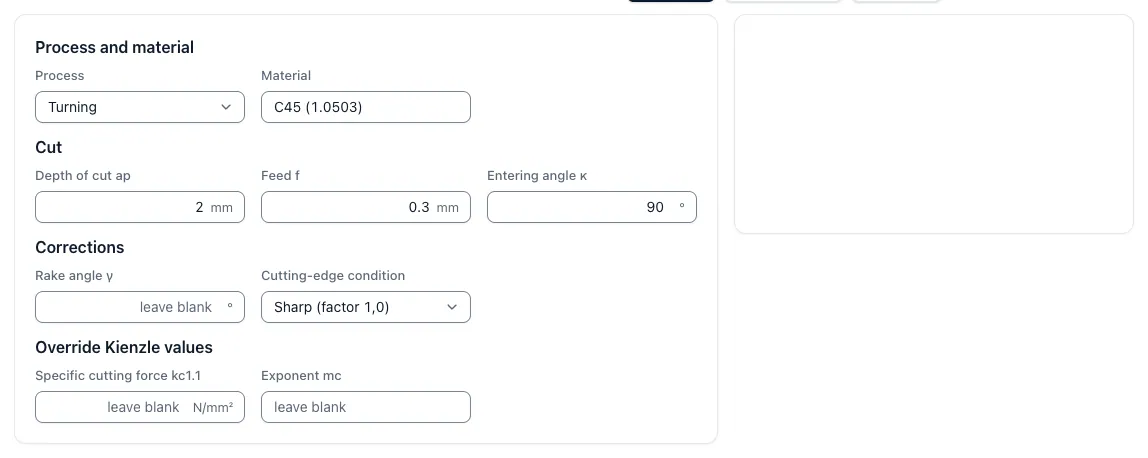
Kienzle describes the specific cutting force kc as the function of the chip thickness h. The main value kc1.1 applies to a chip of 1 mm thickness and 1 mm width, the rise value mc describes how much kc increases with thinner chips. Multiplies with the chip cross section b × h results the main cutting force. Kγ and Kver correct chip angles and wear.
The exponent makes the difference to the calculation with a fixed kc value. If the chip thickness is halved, kc increases by a factor of 2^mc, at mc = 0.25 thus by around 19 percent. Small protrusions and narrow interventions therefore produce less force, but more force per removed cubic millimeter.
Fc = b × h × kc1.1 × h^−mc × Kγ × Kver
Specific cutting force kc
The specific cutting force kc is the cutting force per square millimetre chipping cross-section, given in N/mm². It is not a fixed material value: the thinner the chip, the larger the kc becomes, because friction and deformation at the cutting edge have a larger part of the chipping process.
kc1.1 is the special case for 1 mm chipping thickness and 1 mm chipping width, i.e. the initial value from which kc is calculated for the actual chipping thickness. If you expect a solid kc, you underestimate the force with small advances and overestimate it with large ones.
kc = kc1.1 × h^−mc
Cutting thickness and cutting width when turning and milling
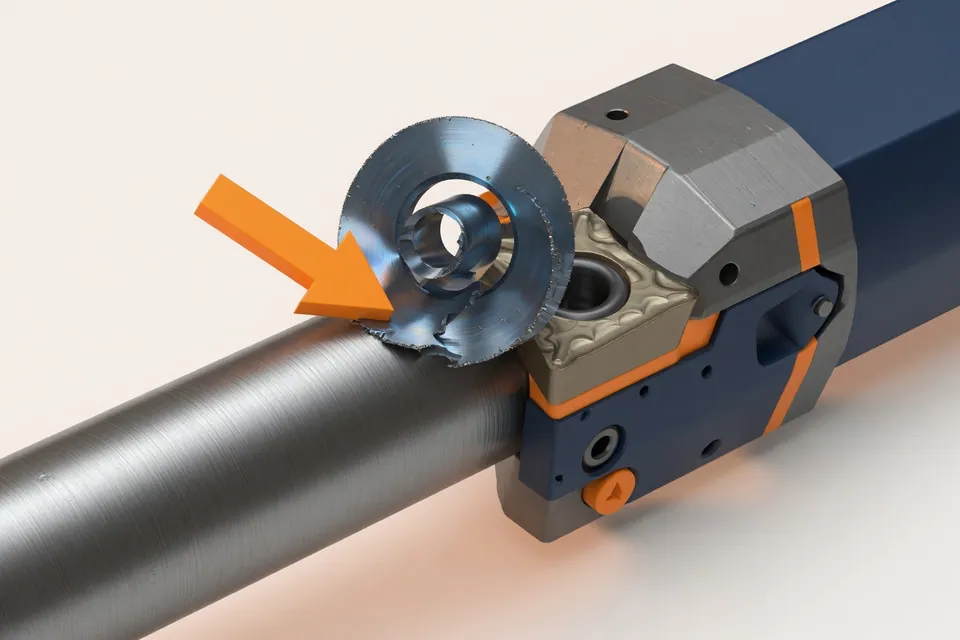
When turning, a cutting edge intervenes in continuous operation. With feed f, cutting depth ap and setting angle κ applies h = f × sin κ and b = ap ÷ sin κ. A smaller adjustment angle makes the chip thinner and wider.
When milling, the teeth are cut one after the other, and the chip thickness changes over the procedure. The calculator uses the average chip thickness from tooth feed fz, cutting width ae and diameter D. The average tangent force Fc,mean = Fc,tooth × z × φs ◆ 360°, plus angle of intervention and torque on the cutter, follows from the force per tooth in the procedure and the average number of simultaneously cutting teeth. If the calculator cuts less than one tooth, it points to the interrupted load, which promotes vibrations and wear.
hm = fz × sin κ × 2 × (ae ÷ D) φs with cos φs = 1 − 2 × ae γ D (φs in arc dimensions)
Starting values for kc1.1 and mc
The calculator takes kc1.1 and mc from the app's material database without its own values. They apply to sharp cuttings and the reference chip angle of 6° for steel and 2° for cast iron. Each degree more chip angle reduces the force by about 1 percent. For normal wear, the calculator calculates a factor of 1.3, for strong with 1.5; for the design of the machine and voltage, you better expect worn cutting.
The database values are starting values. Delivery status and heat treatment move them, binding values are from own experiments or from the tool manufacturer.
kc1.1 and mc per material
Kienzle values for the main cutting force, sharp cutting edge, reference span angle 6° for steel and 2° for casting.
| Material | kc1.1 (N/mm²) | mc | Source |
|---|---|---|---|
| Structural steel S235JR | 1.780 | 0,17 | Material database of the CNC calculator app |
| Remuneration steel C45 | 2.220 | 0,14 | Material database of the CNC calculator app |
| Remuneration steel 42CrMo4 | 2.500 | 0,26 | Material database of the CNC calculator app |
| Stainless steel X5CrNi18-10 (1.4301) | 2.350 | 0,21 | Material database of the CNC calculator app |
| Grey cast iron EN-GJL-250 | 1.160 | 0,26 | Material database of the CNC calculator app |
| Aluminium EN AW-6082 | 830 | 0,23 | Material database of the CNC calculator app |
| Titanium Ti-6Al-4V | 1.450 | 0,23 | Material database of the CNC calculator app |
| Nickel alloy NiCr19Fe19Nb5Mo3 (2,4668) | 2.900 | 0,25 | Material database of the CNC calculator app |
Start values for planning, no measured values of a particular tool. For feed and passivity, own values apply, which the database of the app does not contain.
Example of calculation: longitudinal turning and milling in C45
Longitudinal turning with 3 mm cutting depth, 0.25 mm feed, 95° adjustment angle and sharp cutting, material values from the database. The tensile thickness is 0.25 × sin 95° = 0.249 mm, the tensile width 3 ÷ sin 95° = 3.01 mm. From this follow kc = 2,220 × 0.249^−0.14 ≈ 2,697 N/mm² and Fc ≈ 3.01 × 0.249 × 2,697 ≈ 2,023 N.
With normal wear, the force rises to around 2,630 N, in 42CrMo4 at otherwise identical values to around 2,690 N. At vc = 200 m/min, this corresponds to a cutting performance of about 6.7 kW with sharp cutting and 8.8 kW with worn cutting, before the efficiency of the drive is taken into account.
For comparison milling in C45 with a cutter of 16 mm diameter, four teeth, ae = 4 mm, ap = 12 mm and fz = 0.06 mm. The average chip thickness is 0.029 mm, kc increases to around 3,650 N/mm². A tooth in the procedure carries about 1,255 N, average cutting 0.67 teeth, average tangent force is around 840 N and torque on the cutter is 6.7 Nm.
Pc = Fc × vc 简 60 000
Feeding force during milling and passive force
In addition to the main cutting force Fc, the feed force Ff acts vertically in feed direction and the passive force Fp. For both, the same Kienzle approach can be used with its own material values kf1.1, mf or kp1.1, mp. These values are available in technical tables and manufacturer documents; the app's material database contains only kc1.1 and mc for the main cutting force.
When milling, the feed force also depends on the same or counterflow and the angle of the operation and changes the amount and direction via the procedure. A fixed percentage of Fc is therefore only a rough Anhalt. For voltage and device, the largest force occurring counts, not the mean value.
Measure or calculate cutting force
The cutting force is measured with force measuring platforms under the workpiece or with rotating measuring systems in the spindle, mostly in research, tool development and process optimization. The measurement shows all three force components and their course over the procedure, but needs measurement technology and test time.
Indirectly, the force can be estimated from the power consumption of the spindle: cutting power divided by cutting speed results in the average cutting force, provided the idle power is deducted. For supply and planning, the calculation according to Kienzle with database values is sufficient; it shows early whether spindle, voltage and tool carry the planned cutting values.
Fc ᐅ Pc × 60 000 ÷ vc
What the cutting force decides for process and calculation
The cutting force is followed by power and torque on the spindle, the clamping force that the workpiece must secure against moving, and the deflection of the tool and workpiece. The clamping force calculator of the app shares the force with safety factor by friction value and number of contact surfaces. Feed and passive force depend on material and cutting geometry and are usually significantly below the main cutting force.
For the calculation the force is a plausibility limit. If the spindle, voltage or stability for the planned cutting values are not enough, cutting depth or feed are reduced, and more cuts and more main time are created. Anyone who checks the force before the offer does not calculate any time that is not mobile on the machine.
F_N = S × F ו (μ × n_contact)
Questions and answers
How do you calculate the cutting force when turning?
With Fc = b × h × kc1.1 × h^−mc, with h = f × sin κ and b = ap ÷ sin κ. For C45 with ap = 3 mm, f = 0.25 mm and κ = 95°, the database values of the app are approximately 2.020 N.
What is the specific cutting force?
The cutting force per square millimetre chipping cross-section in N/mm². It rises with thinner chips and is therefore calculated according to Kienzle from kc1.1 and mc for the actual chipping thickness: kc = kc1.1 × h^−mc.
What does kc1.1 mean?
kc1.1 is the specific cutting force for a chip with 1 mm thickness and 1 mm width, given in N/mm². Together with the rise value mc, it describes a material in the Kienzle equation.
Why does the specific cutting force increase with small feed?
Because kc grows with h^−mc: The thinner the chip, the more force is generated by each square millimeter of chipping cross-section. At mc = 0.25, half-span thickness means about 19 percent more kc; the total force decreases nevertheless, because the cross-section becomes smaller.
What is the cutting power when milling?
When milling, one distinguishes the force on a tooth in the procedure and the average force on the milling machine over one revolution. The calculator shows both, including the angle of the intervention, the average number of teeth in the procedure and the torque. For the performance, the average force, for voltage and tool load, also the force per tooth is important.
How large is the feed force during milling?
There is no fixed part of the cutting force: The feed force depends on the same or opposite course, angle of intervention and cutting geometry and changes the amount and direction of the procedure. It is calculated using the same Kienzle approach and its own material values kf1.1 and mf from specialized tables or from the tool manufacturer; the Kienzle calculator of the app calculates the main cutting force.
Where do I calculate the cutting performance?
Cutting power, drive power and torque from material removal rate and specific cutting force are treated to calculate the page power requirement. From the force of this page follows the power via Pc = Fc × vc ÷ 60,000.