Aluminium alloys in cut data finder
The app's cutting data finder has four aluminium-kneading alloys from ISO Group N with its own values: EN AW-6082 (AlMgSi1, 3,2315), EN AW-7075 (AlZn5.5MgCu, 3,4365), EN AW-5083 (AlMg4.5Mn0.7, 3,3547) and the automatic alloy EN AW-2007 (AlCuMgPb, 3,1645). The app's hints describe the differences: 6082 is very easy to cut, polished cutting and high speed avoiding assembly cutting. 7075 is highly resistant, breaks short and achieves very good surfaces. 5083 is soft and greasy, sharp cutting and chipping are important. 2007 forms short breaking chips.
Further varieties are included in the material database of the App with density and standard, but without own cutting data. For EN AW-2024 (AlCu4Mg1, 3.1355), the catalogue refers to 7075, for EN AW-5754 (AlMg3, 3.3535) to 5083.
Start values for milling, turning and drilling
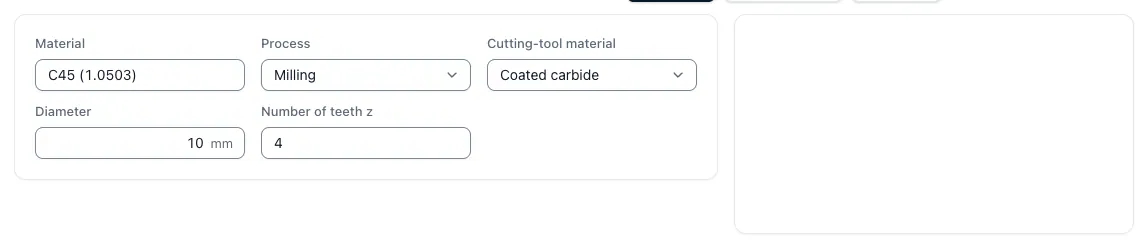
The areas apply according to the app for coated carbide; the tooth feed is indicated for Ø 10 mm, the drill feed for a drill with 10 mm. 6082, 7075 and 2007 share the same speed ranges; they differ mainly in chip formation, surface area and specific cutting force. Data from your tool manufacturer is binding.
- EN AW-6082, EN AW-7075 and EN AW-2007: milling vc 300–800 m/min, fz 0.06–0.15 mm; turning vc 400–1,000 m/min, f 0.10–0.40 mm; drilling vc 150–350 m/min, f 0.12–0.30 mm
- EN AW-5083: milling vc 300–700 m/min, fz 0.06–0.14 mm; turning vc 400–900 m/min, f 0.10–0.40 mm; drilling vc 150–300 m/min, f 0.12–0.28 mm
- Specific cutting force kc1.1: 750 N/mm² (2007), 780 N/mm² (5083), 830 N/mm² (6082), 900 N/mm² (7075), each with mc 0.23
Spindle speed limit
From 550 m/min, a milling machine with a 10 mm diameter results in a speed of around 17,500 1/min. If the maximum speed of the machine is below this, cutting data limit the speed to this value, 12,000 1/min are preset, and points out that cutting speed and feed speed decrease.
In a comparative case with three cuttings, fz 0.105 mm, cutting depth 10 mm and cutting width 5 mm, the cutting speed drops to 377 m/min, the feed speed from around 5,500 to 3,780 mm/min and the material removal rate from 276 to 189 cm³/min. A larger milling machine achieves the same cutting speed with less speed: with 16 mm diameter, approximately 10,900 rpm is sufficient for 550 m/min.
With small cutting widths, for example during trochoidal milling, the chips become thinner than the tooth feed. Cutting data Milling compensates for this chip dilution on request and increases the tooth feed until the maximum chip thickness returns to the catalogue value.
n = vc × 1000 γ (π × D)
material removal rate and drive power
At 0.1 mm chip thickness and 80 % efficiency, according to the material removal rate calculator of the EN AW-6082 app, a kilowatt achieves around 34 cm³/min, at C45 around 16 cm³/min. A spindle with 15 kW is enough for around 510 cm³/min in 6082.
When grinding aluminium, spindle speed, feed axes and chip removal often determine the attainable material removal rate, less often the drive power. The calculator shows material removal rate, required power, load on the drive and the largest material removal rate that allows the input power.
Q = ap × ae × vf 简 1000 Pc = Q × kc 简 60,000
What aluminium costs in the calculation
The main time for aluminium is short: In the comparative case, 100 cm³ chip volume without speed limit are machined in 0.36 minutes, with 12,000 1/min in 0.53 minutes; C45 takes 2.2 minutes for the same volume. This means that non-cutting times, tool changes, set-ups, deburring and the material weigh heavier than for steel parts.
The machine on which the part is to run is therefore crucial for the calculation. The same bag costs less main time on a machine with higher spindle speed, but another machine hourly rate. The stock weight is calculated by the app with 2.70 g/cm³ for 6082, 2.81 g/cm³ for 7075 and 2.66 g/cm³ for 5083.
Questions and answers
Which cutting speed applies to aluminium when milling?
For EN AW-6082, 7075 and 2007 the cutting data finder of the app mentions 300 to 800 m/min for milling with coated carbide with starting value 550 m/min, for EN AW-5083 300 to 700 m/min. The tooth feed for a 10 mm diameter cutter is 0.06 to 0.15 mm.
Does the app have its own values for EN AW-2024 and AlMg3?
No. EN AW-2024 (3.1355, 2.77 g/cm³) and EN AW-5754 (AlMg3, 3.3535, 2.67 g/cm³) are included in the app's material database. For cutting data, the catalogue refers to 7075 at 2024 and to 5083 at 5754; these are starting values, the manufacturer's specifications are the priority.
Why does my machine not reach the recommended cutting speed?
Because the speed of the cutting speed and diameter follows. A 10 mm milling cutter needs around 17,500 rpm for 550 m/min. In cutting data, enter your maximum speed; the app then calculates the achievable cutting speed and the appropriate feed.
Which values apply when turning aluminium?
For 6082, 7075 and 2007, the app lists 400 to 1,000 m/min at 0.10 to 0.40 mm feed per revolution, for 5083 400 to 900 m/min. On a workpiece with a diameter of 50 mm, the starting value of 700 m/min is around 4,460 1/min.