Differentiating belt speed and cutting performance
The speed of the sawmill in m/min is not equal to the cut cross-sectional area per minute. For an estimate of the surface, a measured or load-resistant cut capacity in cm²/min is required. It must fit to material, cross-section, strip and machine.
Therefore, no complete time approach can be derived from the belt speed alone. Starting values of another material group are not taken over unchecked.
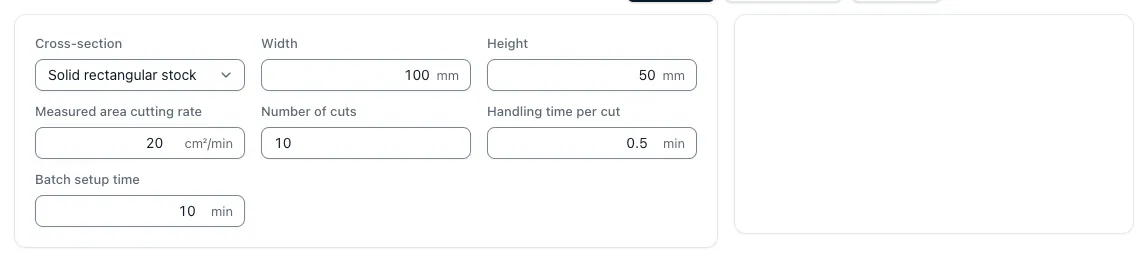
Example of calculation for a round rod
A cross-section with a diameter of 50 mm has an area π × 50² ÷ 4 = 1,963.5 mm², i.e. about 19.635 cm². With assumed previously measured 10 cm²/min, the pure cut takes about 1.9635 minutes.
For ten cuts this is 19,635 minutes. Each 20 seconds of handling add 3,333 minutes, five minutes of setting up together result in about 27,97 minutes. At assumed 45 €/h these times correspond to around 20.98 €. Band wear and material are added, as far as the set does not already contain them.
t_Schnitt = Querschnittsfläche in cm² ÷ Schnittleistung in cm²/min
Making material losses visible
Cutting joint and plan dimensions increase the required section. At the end of the rod, clamping length and remaining piece can prevent further use. For material costs, the actual required purchase quantity counts under the operating residual material rule.
The app calculators for saw addition and Stankenausutzung make these parts visible separately.
When the land model is not sufficient
Tubes, profiles, bundles and interrupted cross-sections may have different cutting conditions. The power used must represent exactly this case. A calculation value does not replace process release and no test of the workpiece tension.
Questions and answers
Can the sawing time be calculated from the belt speed?
Not alone. For an area calculation, you also need a suitable cutting performance in cm²/min or measured cutting times. Band speed and surface performance are different sizes.
Do saw joint and plan dimensions count to the precast weight?
No. They increase the material input of the blank and thus the procurement costs. The finished part weight refers to the finished geometry.