Copper materials in cut data finder
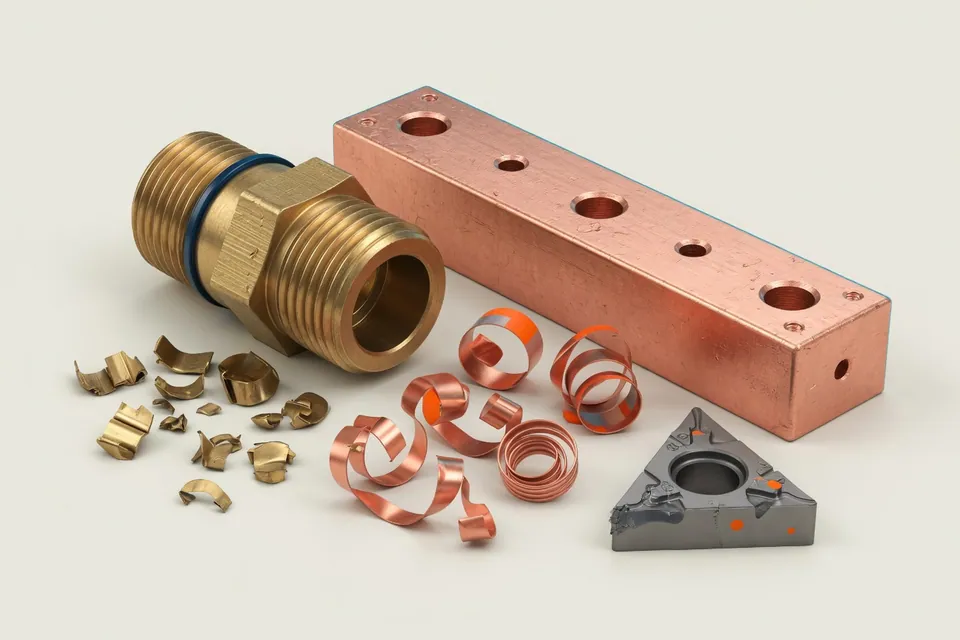
The app leads two copper alloys of the ISO group N with their own cutting data: the machine brass CuZn39Pb3 (2.0401, CW614N, also Ms58) and the pure copper Cu-ETP (2.0065, CW004A, E-Cu). Both can also be found in the material database of the app via these short names.
The app's hints clearly distinguish them. CuZn39Pb3 is very easy to machine; tools with neutral chip angles prevent the tool from moving into the material. Cu-ETP is soft and lubricating, forms long chips and needs sharp, polished cutting. This is also evident in the specific cutting force: kc1.1 is 780 N/mm² with mc 0.18, for copper with 1,100 N/mm² with mc 0.25.
Start values for turning, milling and drilling
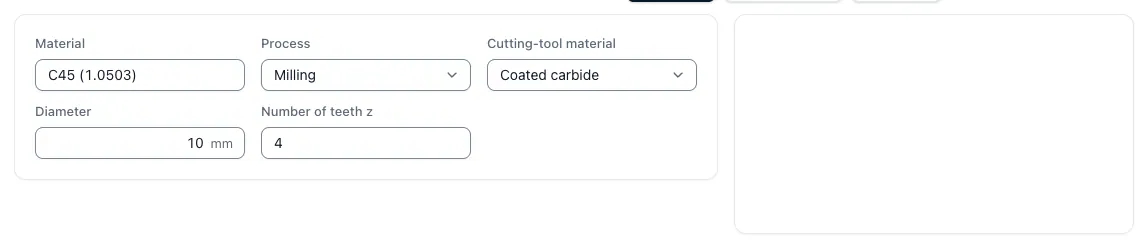
The areas are starting values from the cut data finder of the app for coated carbide. The tooth feed applies to a 10 mm diameter cutter, the drill feed for a 10 mm drill. The data of your tool manufacturer is binding.
At a 20 mm diameter rod, the turning start value for brass of 375 m/min results in about 5,970 rpm. If the spindle limit is below, cutting data calculates turning with the entered maximum speed and indicates the reduced cutting speed.
- CuZn39Pb3, turning: vc 250–500 m/min, start 375 m/min; f 0,10–0,35 mm
- CuZn39Pb3, milling: vc 200–400 m/min, start 300 m/min; fz 0.05–0.12 mm
- CuZn39Pb3, drilling Ø 10 mm: vc 100–250 m/min; f 0.10–0.25 mm
- Cu-ETP, turning: vc 200–400 m/min, start 300 m/min; f 0,10–0,30 mm
- Cu-ETP, milling: vc 150–300 m/min, start 225 m/min; fz 0.04–0.10 mm
- Cu-ETP, drilling Ø 10 mm: vc 80–150 m/min; f 0,08–0.20 mm
Lead-free brass, bronze and special brass
The app's material database contains numerous other copper alloys with density and standard. They do not have their own cutting data; the catalogue refers to CuZn39Pb3 or Cu-ETP. Lead-free brass such as CuZn21Si3P (CW724R) and CuZn42 (CW510L) are assigned to CuZn39Pb3, with the reference to longer chips and higher tool wear. Lead-free knet brass such as CuZn37 (Ms63) and CuZn10 refer to Cu-ETP: use long chips, chipformers and sharp cutting without lead.
Tin bronzes such as CuSn6, CuSn8 (2.1030, CW453K, 8.8 g/cm³) and CuSn12-C refer to Cu-ETP, red casting such as CuSn7Zn4Pb7-C (Rg7) to CuZn39Pb3. For high-strength special brass with aluminium, manganese or nickel, the catalog advises that the cutting speed is significantly lower than the brass values. For beryllium coppers such as CuBe2, a health and safety advice applies: Beryllium-containing dust and smoke are harmful to health, wet processing and suction.
These assignments are starting points for the calculation, no tested cut values. For bronze and special brass the data of the tool manufacturer apply.
Cost effect of turning and milling parts made of brass
Only aluminium has shorter peak times than brass among the app's metals. When turning lengthwise with the pre-setting of cutting data turning, Ø 50 mm, 100 mm cutting length and 2 mm cutting depth, a cut with the starting values in CuZn39Pb3 takes around 11 seconds, in Cu-ETP 16 seconds and in C45 17 seconds. When milling with Ø 10 mm, three cuttings, 10 mm cutting depth and 5 mm cutting width, brass delivers around 122 cm³/min, Cu-ETP 75 cm³/min and C45 46 cm³/min.
The shorter the main time, the stronger the count material, the precise use of the rod, non-cutting times and setups. With 8,47 g/cm³ CuZn39Pb3 is heavier than steel, Cu-ETP is 8,93 g/cm³. The stock weight, material costs and precise use of the rod count on your kilo price in the app.
A change from lead-free brass to lead-free brass changes the calculation over longer chips and more wear. Plan for this to be a new service life and tool costs instead of taking over the values of CuZn39Pb3.
Questions and answers
Which cutting speed applies to brass when turning?
For CuZn39Pb3 (Ms58), the app's cutting data finder lists 250 to 500 m/min with a starting value of 375 m/min and a feed of 0.10 to 0.35 mm per revolution. It is 200 to 400 m/min when milling.
Does the app have cut data for Bronze CuSn8?
No own. CuSn8 (2.1030, CW453K) is located in the app's material database with 8.8 g/cm³, and for cutting data, the catalogue refers to Cu-ETP. This is a starting point; the information provided by the tool manufacturer is binding.
Why does the tool pull itself into brass?
With highly positively ground cutting, the tool can pull itself into the well-machinable material. The app therefore recommends tools with neutral chip angle for CuZn39Pb3.
What changes with lead-free brass?
The app's material catalog points to longer chips and higher tool wear for lead-free grades such as CuZn21Si3P and CuZn42 than for CuZn39Pb3. You should therefore re-evaluate chipformers, service life and tool costs.