Inconel 718 in cut data finder
The app runs the NiCr19Fe19Nb5Mo3 (2.4668, Alloy 718) nickel base alloy in the ISO Group S with its own cutting data. The app has a density of 8.19 g/cm³, a tensile strength of 1.240 to 1.400 N/mm² and a specific cutting force kc1.1 of 2.900 N/mm² with mc 0.25. This means that kc1.1 is above all unhardened steels in the app.
The app's hint is scarce: very hard to machine, use strong cold-solidification, and the manufacturer's cutting data. The values below are therefore explicitly starting values for the calculation, not approval for the production.
Start values for milling, turning and drilling
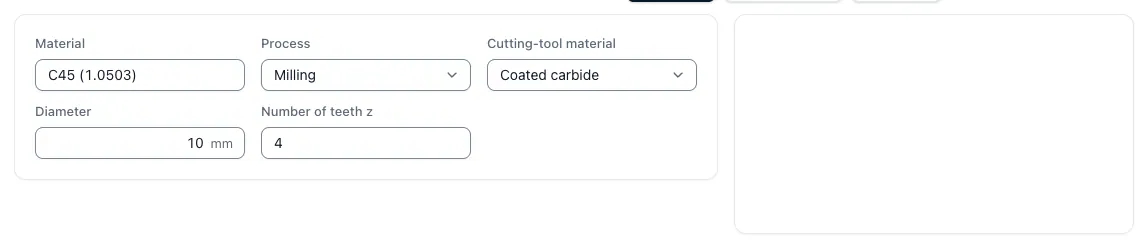
The areas come from the cut data finder of the app for coated carbide. For a 10 mm diameter cutter, the starting value of 32.5 m/min is around 1,035 rpm, with three cuttings and fz 0.035 mm a feed speed of around 110 mm/min.
When turning lengthwise with the pre-setting of cutting data Turning, Ø 50 mm, 100 mm cutting length and 2 mm cutting depth takes approximately 142 seconds, in C45 about 17 seconds. When drilling with Ø 10 mm, the starting values result in a feed speed of around 33 mm/min; a 20 mm deep bore thus requires a pure drilling time of about 36 seconds, in C45 about 2 seconds. For components with many holes, the drilling time therefore belongs as its own part in the calculation.
- Specific cutting strength: kc1.1 = 2,900 N/mm², mc = 0.25
Starting values for milling, turning and drilling: Inconel 718 and C45
| Procedure | vc area | Start value vc | Feed (start value) | C45 for comparison |
|---|---|---|---|---|
| Milling, Ø 10 mm | 20–45 m/min | 32.5 m/min | fz 0,02–0,05 mm (0,035 mm) | vc 160 m/min, fz 0,06 mm |
| Rotate | 30–60 m/min | 45 m/min | f 0,1–0,2 mm (0,15 mm) | vc 205 m/min, f 0,275 mm |
| Drilling, Ø 10 mm | 10–25 m/min | 17.5 m/min | f 0,04–0,08 mm (0,06 mm) | vc 95 m/min, f 0,185 mm |
Starting values from the cut data finder of the app for coated carbide, each center of the range; fz per tooth, f per turn. The data of the tool manufacturer are binding.
Cold solidification and even feed
Nickel-based alloys are strongly solidified when the cutting edge rubs. For related varieties in the catalogue, the note is: use sharp cutting and even feed. Too thin chips are twice unfavorable. According to Kienzle, the specific cutting force increases by a factor of 2^0.25 with half the thickness of the chipping, i.e. by around 19%, and the solidified surface loads the next cut.
When milling with a small cutting width, cutting data balances the chip dilution so that the maximum chip thickness corresponds to the catalogue value. Then check the result with the cutting force calculator, especially at a high cutting depth.
kc = kc1.1 × h^(−mc)
Solvent annealed or hardened
Inconel 718 is hardenable. The heat treatment condition changes strength and hardness and thus cutting power, wear and achievable cutting speed: A solution annealed condition is softer than a hardened one. The values of the app with 1,240 to 1,400 N/mm² Tensile strength describe a firm condition; the condition is stated in the material certificate.
For the calculation this means: Take over the condition from drawing or order, ask as an open question if no information is given and use the cutting values of the tool manufacturer for exactly this condition. If only after grinding is cured, separate operations with own cutting values are created.
Further nickel base alloys in the material catalog
The material database of the app leads numerous other nickel-based alloys with density and material number, such as Alloy 600 (2.4816), Alloy 625 (2.4856), Alloy C-276 (2.4819), Alloy 400 (2.4360) and Alloy X-750 (2.4669). They do not have their own cutting data; the catalogue refers to Inconel 718 for all. The same applies to heat-resistant steels such as Alloy 800 (1.4876) and to cobalt alloys.
The catalogue advises the manufacturer to check the heat treatment state before processing for the hardenable varieties such as Alloy X-750. The reference to Inconel 718 is a starting point for the precalculation; the cutting values for the production come from the tool manufacturer.
Service life and costs per part
In a comparison with a diameter of 10 mm, three cutting edges, 10 mm cutting depth and 5 mm cutting width, the starting values are around 5.4 cm³/min time spanning volume. For 100 cm³ chipping volume, this is 18.5 minutes, in C45 2.2 minutes. The drive power is no bottleneck: With 0.1 mm chipping thickness and 80% efficiency, this time spanning volume requires approximately 0.6 kW.
The price determines the operating time and service life. With the preset Taylor exponent 0.25 of the service life computer, a 10 % higher cutting speed costs around one third of the service life, a 10 % lower lengthening it by about half. Exponent and reference life should be from Inconel's own experiments or from the manufacturer.
In the calculation tool costs are therefore part of the own position. The calculator tool costs per part distributes cutting price and alternating time after intervention time and shows the economic service life; the actual service life from the post-calculation make the next calculation more reliable.
T₂ = T₁ × (vc₁ ÷ vc₂)^(1/n)
Questions and answers
What is the cutting speed for Inconel 718?
The cutting data finder of the app gives for NiCr19Fe19Nb5Mo3 (2.4668) 20 to 45 m/min when milling, 30 to 60 m/min when turning and 10 to 25 m/min when drilling with 10 mm. The app expressly points out to use the manufacturer's cutting data.
Do the values apply to Alloy 625 or Alloy C-276?
Both are in the material database of the app, but do not have their own cutting data; the catalogue refers to Inconel 718. For the precalculation this is a starting point, for the production the information of the tool manufacturer applies.
Why is Inconel's service life so short?
The app provides a tensile strength of 1,240 to 1,400 N/mm², a high specific cutting force and strong cold solidification. Any deviation at cutting speed or chipping thickness therefore has a strong effect on wear.
How do I calculate a component from Inconel?
Time of intervention from cutting data Milling or turning with manufacturer or start values, service life from own data, tool costs per part as their own position and only then machine time and surcharges. This remains visible which part of the price comes from the material.